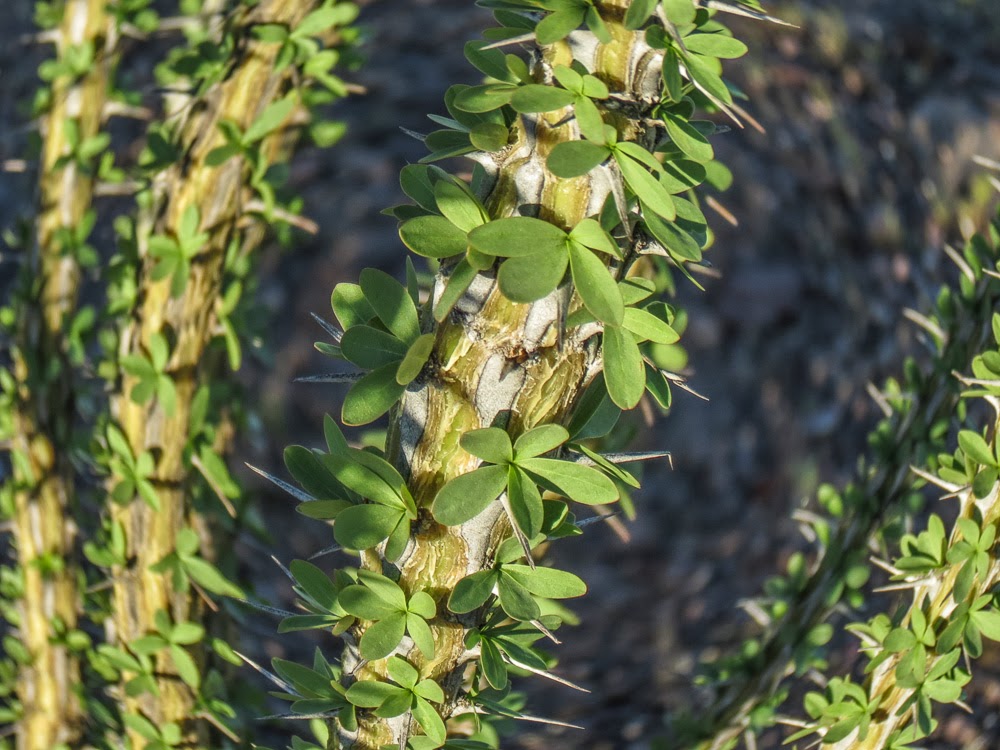
Organ Pipe Cactus National Monument
And Ajo, Arizona

Camp
at Twin Peaks Campground

The
organ pipe cactus does not grow much north of here. This park sits directly on the Mexican
boarder and the cactus is more common to that country than to our own.


Our first experience hiking with saguaro

Hiked into Victoria Mine one morning, an abandon operation
within the monument.

Note the bathtub.
I’ve been missing mine!


A cactus wren. Many
birds here have specialized beaks for getting around the stickers to feed.


Took some doing to extract this from Jason’s boot. The cacti haven’t heard of barbless.


Ajo
was a planned community built in the early 1900s by a mine owner who wanted
good things for his workers, tho eventually a labor strike did break the
mining. Phelps Doge picked it up later
and eventually marketed the small homes—500-600 sq feet—to snow birds as “the
place where summer spends the winter.”


Ajo
felt more like a border town than a mining town. Nonetheless it was reminiscent of the Berkley
Pit, tho this one wasn’t nearly as large.


The coffee place on the town square. The old guys at the shaded table back in the
corner of the patio are like the old guys at morning coffee in every small town. Gamers anyone?!

Protestants

Catholics

A hummingbird nest is not too much bigger than thimble. It was certainly smaller in diameter than a
half dollar. For perspective, the white
is an orange blossom.

The Curley School

This
school was renovated by HUD and is now an “artists colony” in a multibuilding
complex. The big old school now houses
reportedly spacioius nice apartments and studio space which artists can rent
inexpensively. The top rent we found was
600/month. Hmm ...

The park brochures warn against speaking to anyone with a
black water bottle—painted black to decrease reflection and, therefore,
detection.
The desert insists on it’s own terms. Not much spirit of compromise. You bow to its relentless heat and prickly
nature. If you don’t, it brings you to
your knees. One way or another, it puts
one in the praying position. We often
kneel to shoot.
It’s been humbling walking day after day in desert after
desert. We’ve been watching plants make
adjustments and adaptations to even slight variations in moisture and
altitude. Resources and expenditures
used precisely for survival—practical, sensible, elegant. There isn’t much left
over so I admire the cultures that have lived from desert resources. More about the saguaro in our next blog.
Pipe Organ National
Monument was a kind of non-choice—it chose us. We needed a small repair on Seven (our
trailer for those of you don’t know her yet) and the Tucson dealership had the
nearest available next appointment and we had some time to kill. Organ Pipe was a good half way stop. On all the highways near the border there are
multiple patrol checkpoints east and west, north and south.
One morning early coming out of the campground into Ajo (for
my monthly clinic Skype meeting) I drove through a check point, creeping
forward with my windows down. The agent
on the driver’s side greeting me with a good morning and a gesture I thought
waved me through. As I rolled forward two agents were shouting for me to stop,
which I did instantly and they were immediately in each open window. “Didn’t you see that stop sign, lady? When you see that, you stop,” loudly from the
passenger’s side, a bloated angry frustrated face.
“I’m so sorry. I
thought I was waved through as we have been in the past.”
Then the agent at my elbow gentling and soft, “It’s
alright. We understand.” Pause and then, “Are you a US citizen? Okay then, and next
time please stop.” I realize after that the “wave through” only happens north
to south.
All volunteers, agents and just plain folks in Organ Pipe
National Monument, the communities of Ajo and Why acknowledge the level of
“illegal activity” in the area. Human
trafficking and wholesale illegal substances are common. Seems incongruous that it is criminal to need
work, and then go to a place someone wants to give you a job. It felt real tender walking through the early
mornings on trails that had evidence of migrants passing in the night.
Here humans in distress are a more primary concern than the stickers,
reptiles, mammals or birds. The sharp distinction between day and night is what
keeps things alive and safe—including us.
We were welcomed on sanctioned trails in the day. We didn’t leave them and we never walk in the
dark anyway. Here is the first place we
were admonished not to.
Day and night. Paul
Johnson and Linda Robbins told us they were in Ajo once in August and that all
activity occurred an hour or two before sunrise and again at dusk. Not just animals, even the people spent
midday still and inside.
Yeah, Helena folks! Thanks
to George Shunk. Paul and Linda invited
us over. When I drove up, out bounds Linda
Stoll. She lives one door down. They have purchased and are improving the
small homes built in the early 1900s for miners. I kick myself for the photographs I
missed. Paul and Linda have done an
amazing and beautiful job with their home and yard. Linda is working hard on hers too and it’s
already great.
Another missed photo occurred when I came around the front
of Seven in camp, my hands full, and I almost stepped on a 4-ft rattle
snake. Moving away from me I never felt
fear, and only amazement at its patterns and motion.
Missed a nighttime shot of javelina—aka desert pig. Sturdy looking critters with big thick
snouts, black, snuffling and snorting. I
woke hearing something around our camp, right by our trailer and truck. Decided it was prudent to take a look and
found three of the critters–two big (maybe 40-50 pounds, a little bigger than
our Zach) and one young ‘un. Jase woke
up and had a look too. They disappeared
rather efficiently, seemingly oblivious to us.
In Ajo they are the resident, and sometimes troublesome, wild life like
our mule deer.
Ajo felt really good to us.
Partly for the generous Helena welcome.
Partly for its isolation—80 miles to the nearest box store. We
liked the border town feel and are curious about the Curley School. It has been renovated into apartments for
resident artists and has studio spaces in the apartments or near them. For me it was the first place that I thought,
yeah, we could live here all winter. We could live in one of those apartments;
keep a pick up camper for forays into landscape.
Walking the town one morning an old guy, Bruce, invited me
to check out his garden and home. He has
lemons, limes, grapefruit, oranges and tangelos. He has all manner of greens and tomatoes in
his green house. The humming birds blew
me away. He kept saying, get closer,
they don’t mind.
I have wondered at the stark humbling, on your knees,
spiritual edge of this environment.
Maybe it’s the retirement adjustment. Maybe our Montana environments
engage majesty as this does humility. At
home the landscape lifts me up. Here I am on my knees and being shown gratitude
from close to the ground. Who said (John
Updike?), “the desert is the palm of the hand of god.” Seems about right to me. We are held in the palm of something vast.